Vaaradhi Farms
A full year of Meta, Google and WhatsApp run as one system — acquisition, brand capture and retention feeding each other.

Client
Vaaradhi Farms
Industry
D2C ecommerce · India
Timeline
12 months, Jan–Dec 2025
Services
Paid Media, Growth Analytics
The challenge
Vaaradhi Farms is a Hyderabad-based D2C brand selling farm-sourced natural products — A2 desi cow ghee, wild raw honey, organic jaggery, pickles and turmeric — entirely through its own storefront. With no marketplace presence and no retail footprint, paid media was not one lever among several. It was the whole acquisition engine.
Growing that engine profitably over a full year meant solving three problems at once: acquiring new customers at a cost the margins could absorb, capturing the brand demand that acquisition was creating before someone else did, and getting existing customers to buy again rather than paying to reacquire them.
What we did
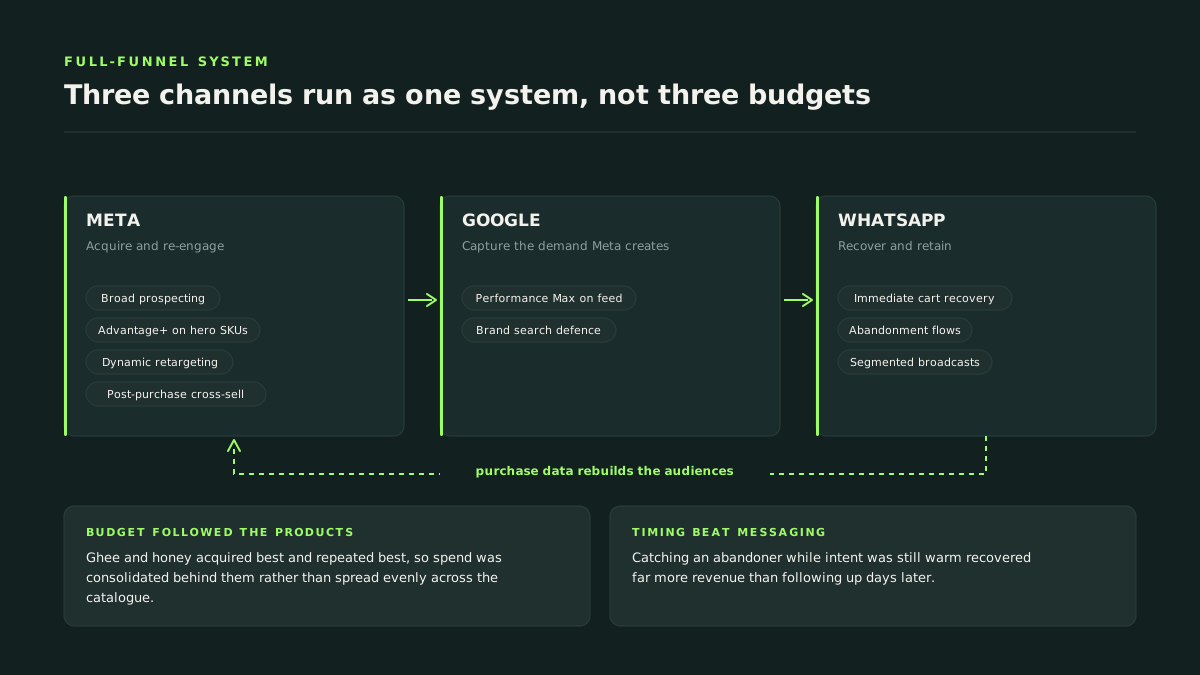
Three channels were run as one system rather than three budgets. Meta acquired and re-engaged, Google captured the demand Meta created, and WhatsApp did the work neither could — reaching people who had already bought, at the moment they were ready to buy again.
A full-funnel Meta structure, not a campaign list. Six core campaigns each with a defined job: dynamic retargeting against cart and checkout abandoners, two Advantage+ Shopping campaigns on the hero SKU, two broad prospecting campaigns at fixed daily budgets to keep new-customer flow continuous, and a post-purchase campaign cross-selling honey to ghee buyers.
Budget concentrated on the products that carried the brand. Ghee and honey were identified early as the SKUs that acquired best and repeated best, and spend was consolidated behind them rather than spread evenly across the catalogue.
Google split by demand type. A Performance Max feed campaign chased category demand across Search, Shopping, Display and YouTube. A separate brand search campaign, capped at a modest daily budget, defended the brand terms that Meta activity was generating.
WhatsApp automation before WhatsApp broadcasting. Behavioural flows fired on cart, product and collection page abandonment, with a 30-minute cart recovery flow catching abandoners while intent was still warm.
Segmented broadcasts, not blasts. Festive campaigns were sent to segments built from purchase history, recency, city and spend value — high-value jaggery buyers with three or more orders, ghee and honey purchasers inactive for 30 days in Hyderabad — rather than to the full list.
Creative followed the same discipline. Comparison statics, behind-the-scenes process video and recipe content each did a different job in a different part of the funnel, and the product feed carried the retargeting.
The outcome
Meta held a 6.07x purchase return across the full year, with monthly purchases roughly doubling between January and Q4 as audience data and creative learnings compounded. Retargeting against warm audiences was the single largest revenue contributor; the two Advantage+ campaigns on ghee sat between 6.06x and 6.67x.
Google was the efficiency story. The brand search campaign, held to a modest daily budget, returned 42.4x on spend — the most capital-efficient line in the account across all three channels, and a direct read on the brand equity the Meta activity was building. Performance Max scaled from close to nothing in February to its strongest month in December.
WhatsApp closed the loop. Automated flows recovered a meaningful share of abandoned checkouts, with the 30-minute cart recovery message returning a 20.8% click-through rate and outperforming the three-day follow-up by more than three to one on revenue. Catching an abandoner while intent is still warm turned out to matter more than anything in the message itself.
Meta purchase ROAS, full year
Brand search ROAS
Click-through on 30-minute cart recovery


